

The Capture
The Ascension Into the Virtual

The village raised the child for most of human history. The family, the tribe, an extended community embedded in shared myth and mutual obligation. That arrangement has been coming apart for decades. What moved into its place didn't arrive by accident. It arrived with an infrastructure, a funding model, and an agenda.
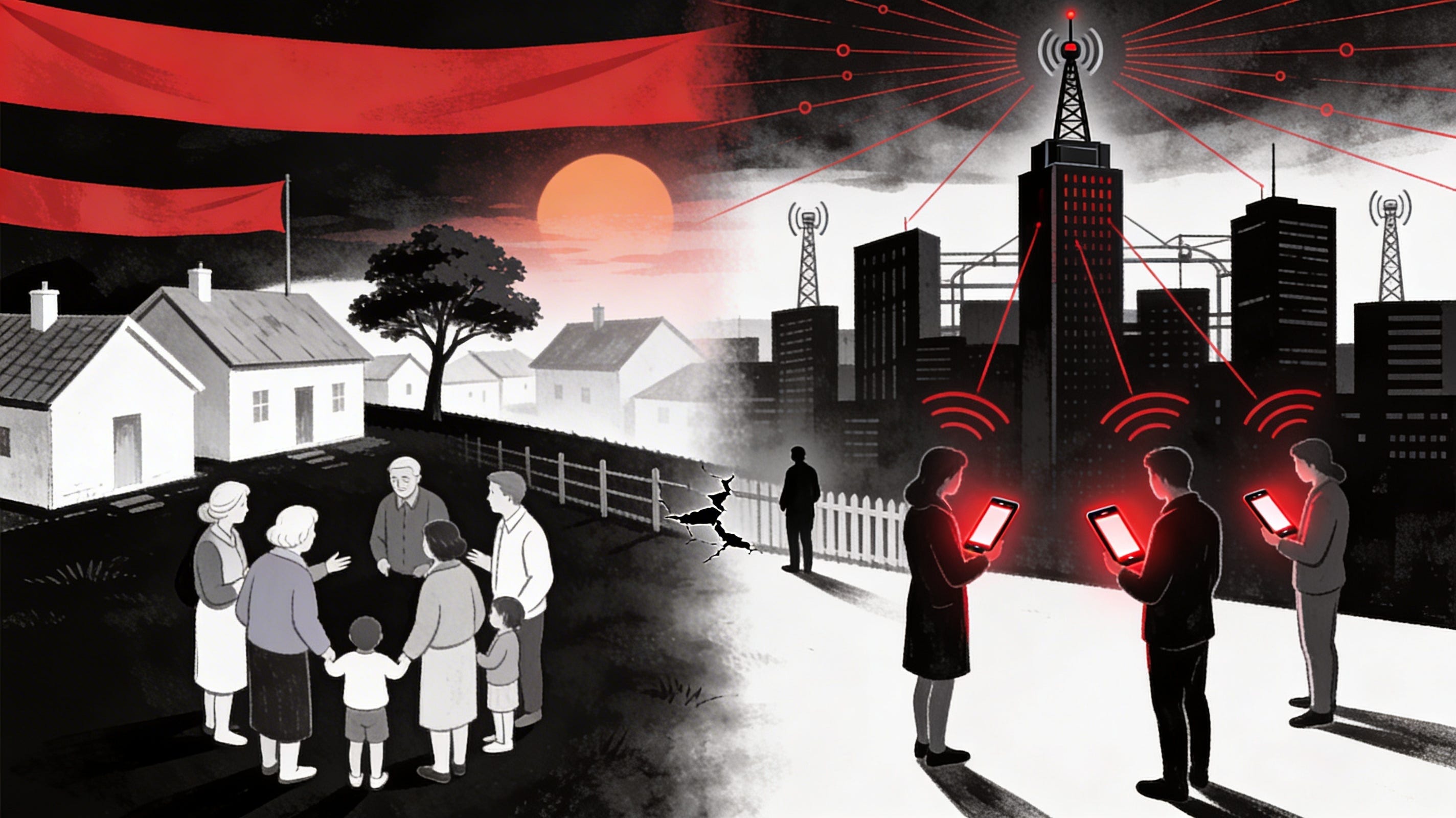
As my grandparents grew up, they knew their neighbors well. They knew who was struggling and who was doing well, who just had a baby, and who had problems with their mother. The information moved without infrastructure, without an algorithm, without anyone profiting from its movement.
That world is largely gone. What replaced it isn’t a failure of individual virtue. It’s the predictable outcome of specific economic and structural conditions that have made the communal life my grandparents knew not just uncommon, but in most American cities, nearly impossible.
The numbers confirm what most people already sense. The American marriage rate has fallen from 9.8 per 1,000 people in 1990, to 6 per 1,000 by 2021, while 40–50% of first marriages and 60–67% of second marriages end in divorce, at a national average cost of $19,000.
Taken together, the math doesn’t just describe a trend but a verdict — a collective, largely unspoken conclusion that marriage is a bad bet.
Roughly 25% of children under 18 now live with a single parent, 74–80% of whom are mothers, earning an average annual income of $39,964 against household expenses that routinely exceed $50,000 to $100,000 depending on the state.
These numbers leave no room for anything beyond survival.
When a parent cannot afford to be present — not emotionally absent, but structurally, economically unavailable — the emptiness doesn’t stay empty. It gets filled by whatever is cheapest, most available, and most engineered to hold attention.
The Screen.
Unlike the village elder, the grandmother, or the older child in the communal yard, the screens we look through have no interest in the child’s formation. Their only interest is engagement.
Dr. Gabor Maté has conducted extensive research into how the stress primary caregivers carry transfers to their children. During a podcast interview, Maté says,
“Financial stress on the parents transfers into physiological stress in the children. Those children may want to tune out because it’s too much to be in their parents’ presence. Some of them will be diagnosed with ADHD. They didn’t inherit anything in terms of a disease; they’re just reacting to the environment. So, if we’re diagnosing more and more kids these days, I think it’s because the parenting environment has become much more stressed” (Barlett 2022).
As children tune out, they discover that technology can transport them away from the tension of the household, into worlds more vivid and more manageable than the one they’re trapped in.
The caregiver, running the same calculation, reaches for the same exit. When the parent tunes out, they model the behavior. The habit becomes shared, then normal, then invisible.
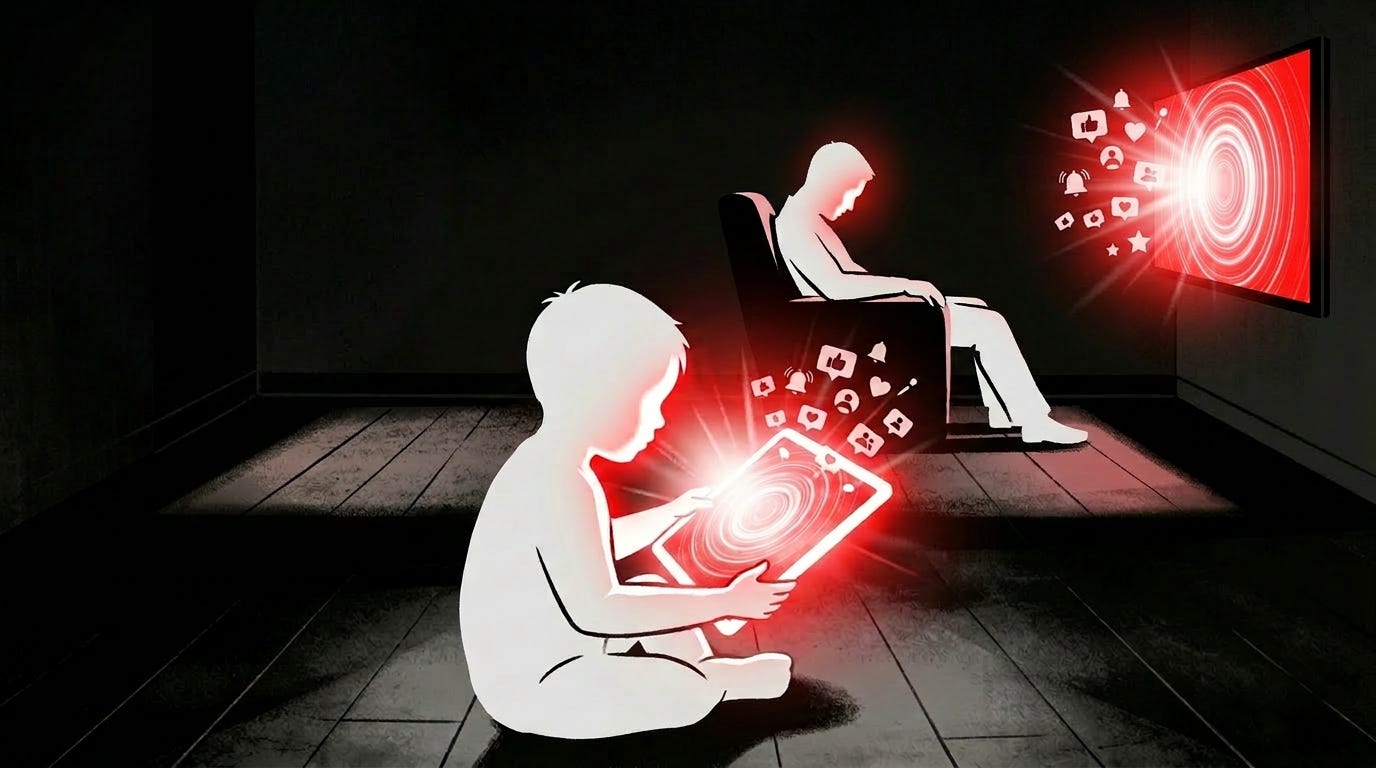
I am not writing this from outside the system I’m describing. I grew up escaping into screens, and I carry that wiring with me.
I know what it feels like to reach for a device instead of people, to prefer the controlled intensity and the degree of separation from stimuli over the unpredictable friction of actual presence.
Video games have gotten so intense that it’s turned down normal life to a degree impossible to measure. I know the escape of it, and I know the relief of it. I’ve felt it.
It’s so easy to call video games a relief or rest, when it’s actually retreat.
The corporations didn’t manufacture that instinct from nothing. They found it, studied it, and built an entire industry on top of it. The appetite was already there. They just learned to feed it, to us, and the following generations.
As I grew up, television and video games were the mediums I escaped into. Today, children learn to navigate the iPad before they learn to speak.
When I was a child, the television and the computer were new enough that nobody thought to ask what they were making us into. By the time anyone figured it out, they were already everywhere.
They figure out how to swipe screens and tap apps before saying “mama.”
The content they find there is immersive, engineered, and bottomless — and it teaches the child, early and thoroughly, that feeling can be produced on demand.
But something more troubling is happening beneath the surface of that absorption.
A child raised more by screens than by faces learns a particular kind of relational distance. They experience intensity from the virtual environments (because the content is engineered to be intense) without intimacy.
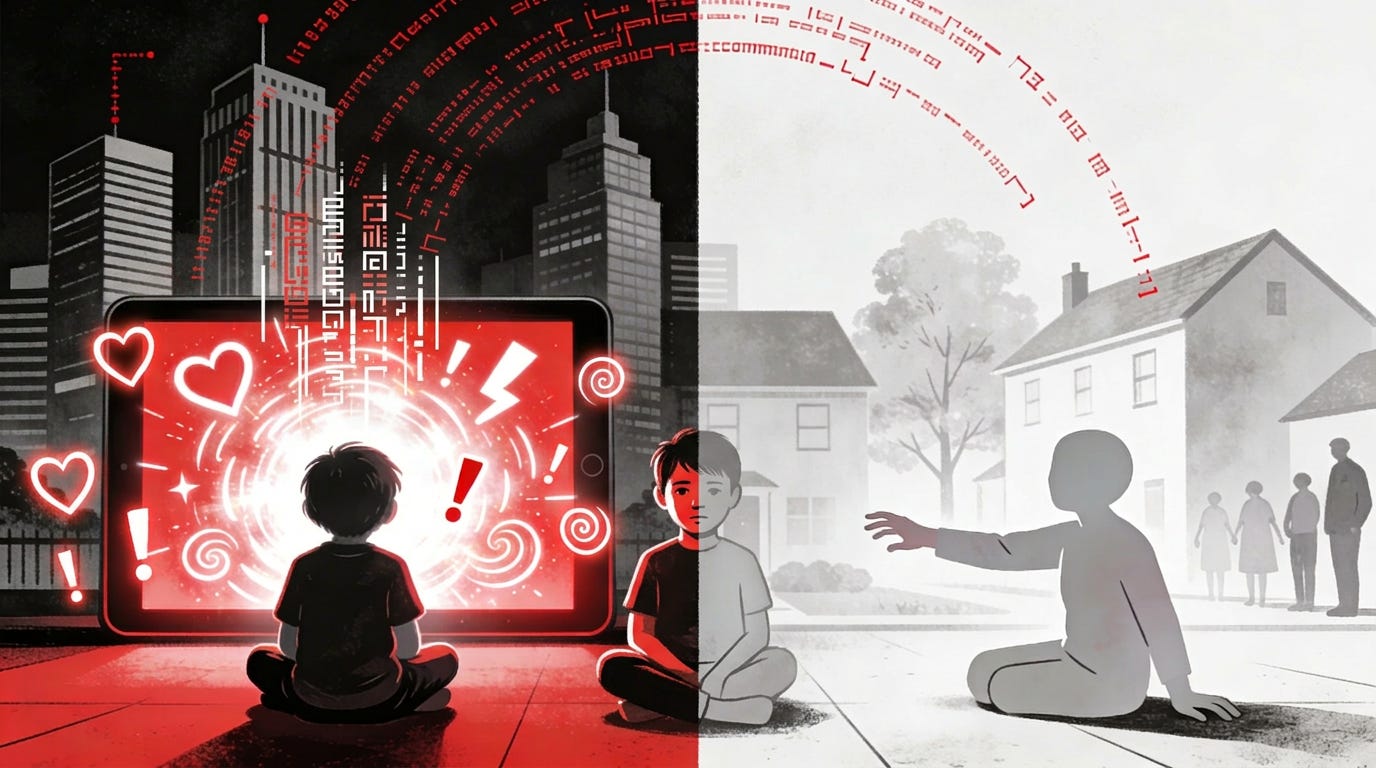
They become capable of strong feelings in the presence of a device and curiously flat in the presence of a person. Lacking the social skills, they feel as if they’re simply not there
This is not numbness; it’s a kind of inverted emotional life, vivid in the virtual and muted in the real.
These children may eventually carry an enormous, inarticulate guilt — not for anything they did, but for what they were never given and never learned to be. We have yet to understand the consequences.
The deeper horror isn’t simply that corporations are babysitting our children. It’s that children grow up having never developed the tolerance for an unmediated experience that would allow them to want something other than the feed.
The appetite for distraction becomes its own kind of need, manufactured at the neurological level before the child has language for what’s happening.
The question is no longer just who is raising our children. It’s whether the cognitive and emotional infrastructure required for a human child — the capacity to endure silence, to read a face, to sit with discomfort — is being sustained at all.
What is quietly disappearing inside this shift is something we rarely name as a loss: participatory knowing. The felt sense of belonging to a particular place, community, and web of relationships.
This is not loneliness, it is something deeper — an epistemological wound.
The child who knows the names of forty YouTube personalities but cannot name a single neighbor has not merely missed out on social connection; their very sense of what is real, what matters, and where they belong is being calibrated by recommendation systems designed to maximize engagement.
The memories formed through media can be as vivid as those from lived experience, sometimes even more so.
The human mind, it turns out, doesn’t much care about the difference. And the corporations building these systems have known that for a long time.
To the extent that we share lived experiences through media, we are also being sold them. Media doesn’t just reflect culture. It actively produces it, instructing audiences on what is desirable, deviant, normal, and true.
No longer passive producers of entertainment, corporations have become the primary architects of our collective worldview, scripting the stories, engineering public perception, and ultimately defining the reality we inhabit.
We adopt the aesthetics of this manufactured world without quite choosing to, aligning our tastes, our language, and our sense of self with images promoted by people paid to promote them.
The question is not whether they are being shaped by it — they are — but whether the category of a genuinely human upbringing is still available at all.
It is worth pausing here to make a distinction that this argument requires. The problem is not the media itself.
A book is a medium. A church sermon is a medium. The communal fire with a storyteller is a medium.
Human beings have always shaped their children through story, image, and inherited form.
The question has never been whether to mediate experience, but who does the mediating, toward what end, and with what relationship to the child’s actual formation?
What is new, and what is the real issue of the current arrangement? The dominant media shaping society today was not designed to form anyone — they were designed to capture attention and monetize it.
The difference between a grandmother telling a story and an algorithm serving a video is not a difference of medium. It is a difference of intent. One is oriented toward the individual. The other is oriented toward the individual’s engagement, indefinitely for profit.
To confront this reality is not to despair, but to see clearly.
The revolt this moment demands is not utopian. It is not “rebuild the village” or “dismantle Silicon Valley.” The response to this, if there is one, won’t be a movement. It will be scattered, local, and largely invisible — people who have looked at what the mediated life costs and decided, quietly, to refuse it.
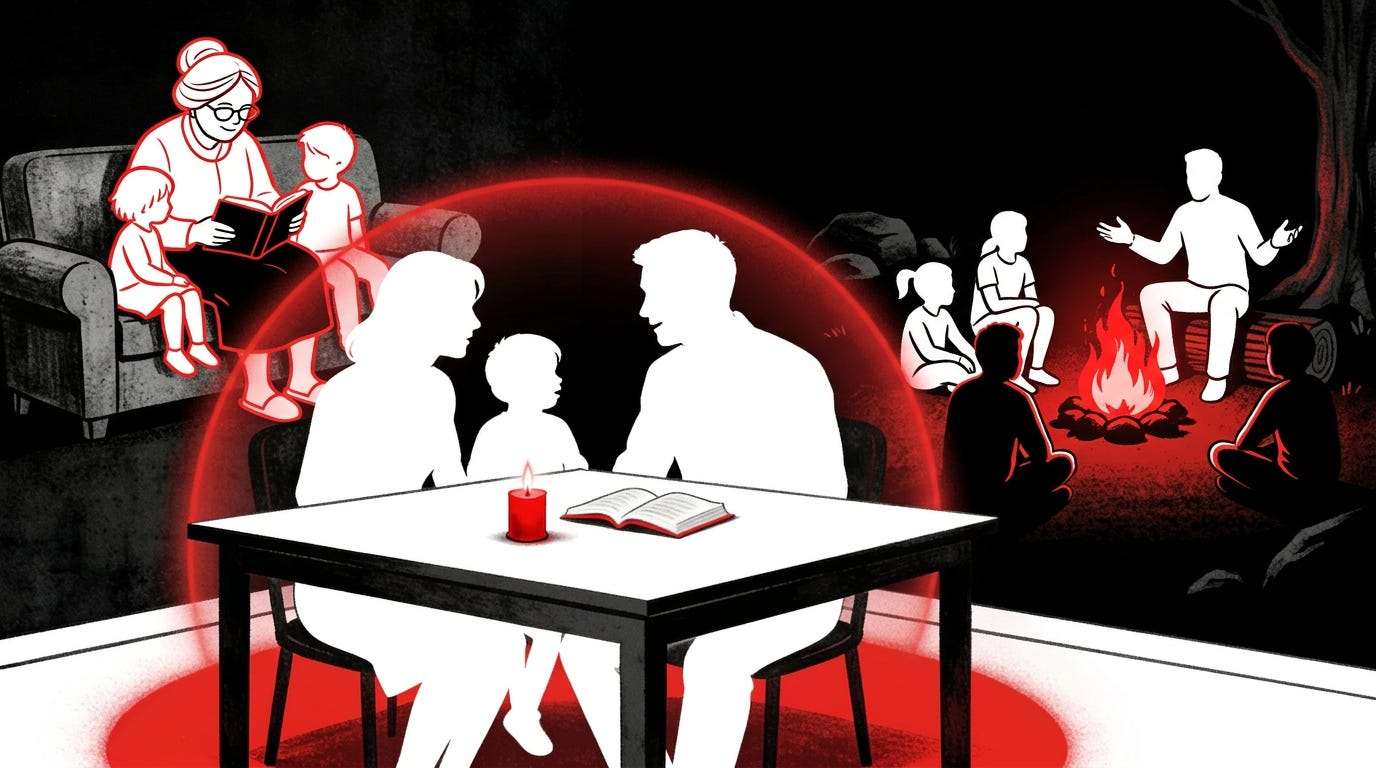
Not utopians. Not luddites. Just people rebuilding the conditions for presence, one household and one neighborhood at a time.
Be warned: the revolt will be packaged and sold back to you. The screen-free life will become an aesthetic. Resist that too.
It will look like a dinner table with no phones. A neighborhood where people actually know each other. A child who is sometimes bored and learns to survive it. A child who has been genuinely seen by another human being, and carries something the algorithm cannot produce and cannot take away.
These aren’t solutions. They’re acts of maintenance — keeping something human alive in an environment designed to replace it.
Turn the screen off for one hour and sit with your child in the discomfort of unmediated presence. Do it again tomorrow. Not because it will save civilization. Because it is the only honest thing available to you right now, in this body, in this house.
If you've read this far and felt the weight of recognition, that feeling is not an accusation. It is the beginning of something more honest than comfort.

Verum Esse — to be true. That's the whole project.