
Narcosis
Disassociation by Extension

Marshall McLuhan believed that every medium is an extension of a human faculty. The wheel extends the foot. The book extends the eye. The microphone extends the voice. Each technology amplifies something we could already do — reaching further, seeing more, speaking louder — and in doing so, changes the ratio of our senses and the shape of our attention.
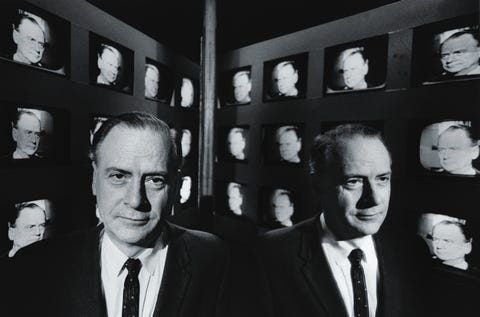
But every extension carries a hidden cost. McLuhan called it amputation. When a faculty gets extended through a medium, the nervous system numbs itself to the extended part. The sensation migrates outward into the tool, and the original faculty goes quiet. The surgeon who delegates to robots loses the sensitivity in his hands. The navigator who follows GPS loses the instinct for landscape. We gain precision. We lose feel.
McLuhan called this Narcosis — from the same Greek root as Narcissus. The numbness that sets in when we extend ourselves through a medium and lose sensation in the part of ourselves we extended. The tool becomes the thing we feel through. The original limb forgets it was ever alive.
What made McLuhan genuinely prophetic was what he saw coming next. When the medium extends not just a single faculty — the foot, the eye, the voice — but the central nervous system itself, the narcosis is no longer local. It is total. The internet, the smartphone, the feed — these are not extensions of any one sense. They are extensions of the entire sensorium, the whole apparatus of human awareness projected outward into a global network. And when the nervous system extends itself that completely, the numbness that follows is not felt in one limb. It is felt everywhere, simultaneously, as a kind of baseline condition so pervasive it stops registering as numbness at all.
It simply feels like normal.
What gets numbed doesn’t disappear entirely. McLuhan understood that too. The amputated faculty goes underground, resurfaces as obsession, as phantom sensation, as the persistent feeling that something is missing without ever being able to name what it is.
The man who drives everywhere still dreams of walking. The culture that outsourced its memory still aches for myth. And the person who extended their identity into a profile still feels, when the screen goes dark, the faint presence of a self that remains neglected.
This phenomenon did not begin with technology. It began with a man kneeling at the edge of a pool
The legend of Narcissus has been misread for thousands of years. The problem was never self-love. It was self-extension.
McLuhan saw in Narcissus something more troubling than obsession. He saw a man whose attention had migrated so completely into the reflection that the body kneeling at the water’s edge had become a vessel — only necessary insofar as it kept the reflection visible.
This human tendency is more common than it seems, and here’s how it gets exploited today.
Narcissus didn’t love himself — he didn’t even recognize himself. He gazed at an extension of his own form, mistook it for something outside him, and became its servant. McLuhan called this narcosis: the numbness that sets in when we extend ourselves through a medium and lose sensation in the part of ourselves we extended. The myth had little to do with vanity and everything to do with the dissociative numbing effect of peering through a medium at something captivating.
Narcissus had to accept the reflection the water gave him. Today, we are not so constrained. The modern image can be edited, filtered, curated, and retried until it produces the response we were hoping for. Narcissus’ fate was once a myth. It is now a growing collective condition. Only, we don’t fall in and drown — we simply waste away.
Today, Narcissus’ silvery, undisturbed spring has become the glassy black screen of the device in your hand. The reflection has become the profile.
To love an image of yourself more than yourself is the modern sacrificial act. You are not performing — you are operating. Pulling the strings of a puppet that wears your face, that speaks in your approximate voice, that accumulates the responses you were hoping for. The virtual persona of the ideal.
The Self atrophies not through drama but through migration. Life-energy slowly rerouted toward a figure that cannot feel it.
Have you had the experience of meeting someone who cannot put their phone away? Who checks social media to constantly be informed? Who cannot see a self that's severed from constant connection?
We become what we pay attention to, but that cuts both ways. Our attention is the most consequential thing we control. Directed well, it builds wisdom, deepens presence, and grows the self. Directed poorly, it hollows us out from the inside without ever announcing itself as the cause.
Unlike Narcissus, we can look up. We can notice the numbness, name it, and slowly will our way toward training our attention.
We are Narcissus if he had a reflection he could edit. Meanwhile, the body ages. Opportunities pass. Real relationships fade. Time does not wait for us to look up. No notification arrives to tell you what you missed. We’d probably ignore that one anyways.
But the Self that atrophied through neglect can be recovered through the same function that depleted it. Not dramatically, not all at once, but consistently.
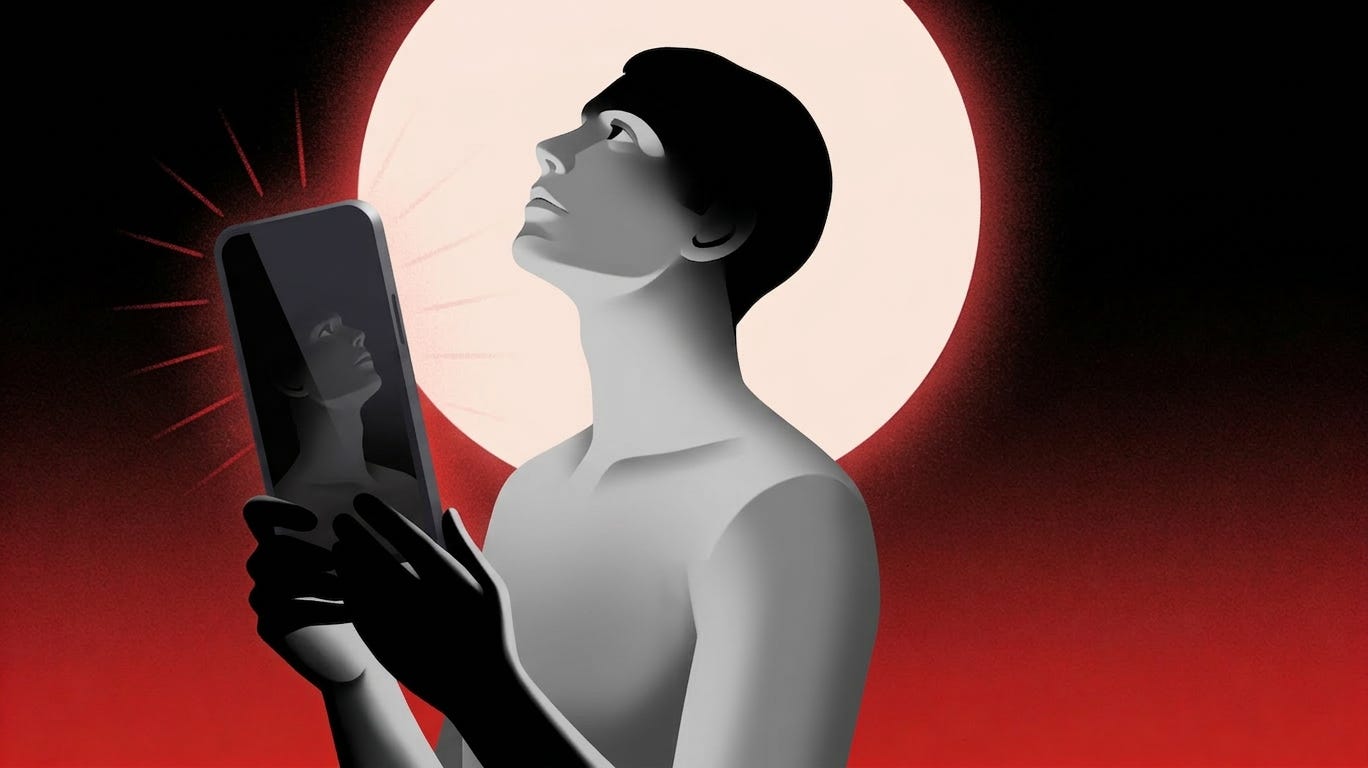
There is still opportunity to claim what life you have left. Not by destroying the technology or abandoning the profile, but by remembering, again and again, which one of them is actually alive.
Integration doesn’t require a retreat or a guru. It requires the repeated, unglamorous decision to return to the body, to the breath, to the people in the same room. Mindfulness is simply the practice of catching yourself mid-drift and choosing differently. Not once. Repeatedly. That repetition is the work.
This is the rebellious act of our time.
The work, then, is not complicated. It is simply hard to integrate. Let me help.
What’s your posture like as you read this? Are you slightly hunched over? Are your shoulders tensed up or low and relaxed? Are your breaths short and shallow, or full and deep? How hydrated are you? How do you feel right now as you assess yourself — or as you’re quickly reading through this?
Inhale. Then exhale for longer. Longer exhales calm the nervous system and increase stabilization. Repeat this once a day — see what happens.
This is where it starts. Not in a concept, but in a body, in a breath, in your localized reality for thirty seconds. Then for a minute, then for five minutes, and so on.
Frank Herbert wrote, “Since every individual is accountable ultimately to the self, the formation of that self demands our utmost care and attention.” The reflection can be put down. The strings can be dropped. What remains is you. Unmanaged. Unfiltered. Alive.